U Visa Requirements in 2026: Who Qualifies and How to Apply
Learn who qualifies for a U Visa in 2026, what crimes qualify, how Form I-918B works, police cooperation requirements, and common U Visa mistakes that may cause denials.
If you have been hurt or scammed, the U Visa may help you.
U Visa Requirements in 2026: Who Qualifies and How to Apply
What Is a U Visa?
The U Visa is a humanitarian immigration benefit created for victims of certain crimes who suffered substantial physical and mental harm and helped law enforcement investigate or prosecute the crime.
A U Visa may help eligible immigrants:
receive lawful status in the United States,
obtain a U Visa work permit,
receive protection from deportation,
include qualifying family members,
and eventually apply for lawful permanent residence.
To qualify for a U Visa in 2026, applicants generally must:
be a victim of a qualifying crime,
suffer substantial physical and mental abuse,
cooperate with police or prosecutors,
obtain a signed U Visa certification (Form I-918B),
and show admissibility or qualify for a waiver.
Who Qualifies for a U Visa?
A person may qualify for a U Visa if they were the victim of a qualifying criminal activity, suffered substantial harm, and cooperated with law enforcement during the investigation or prosecution.
Basic U Visa Requirements in 2026
To qualify for a U Visa, USCIS generally requires applicants to prove:
they were a victim of a qualifying crime,
they suffered substantial physical and mental abuse,
they have information about the crime,
they cooperated with law enforcement,
a law enforcement agency signed Form I-918B,
and they are admissible or eligible for a waiver.
Many immigrants incorrectly believe they cannot apply because they:
crossed the border without inspection,
overstayed a visa,
worked without authorization,
or are currently in removal proceedings.
However, the U Visa was specifically created to protect victims of certain crimes regardless of immigrant status.
What Crimes Qualify for a U Visa?
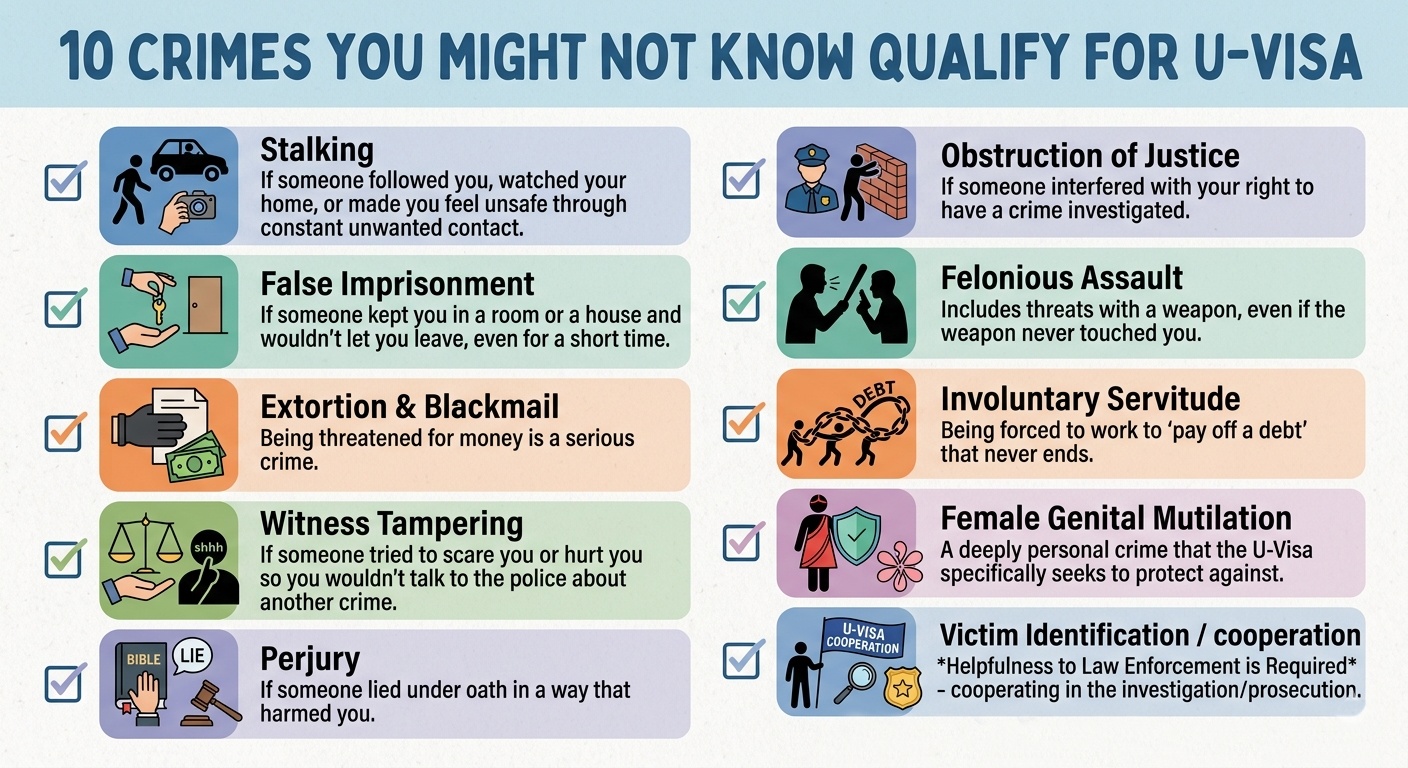
USCIS recognizes more than 28 qualifying criminal activities for U Visa eligibility, including domestic violence, sexual assault, stalking, trafficking, extortion, fraud, kidnapping, and felonious assault.
Common U Visa Crimes
Common qualifying criminal activities include:
domestic violence,
sexual assault,
stalking,
kidnapping,
trafficking,
felonious assault,
witness tampering,
obstruction of justice,
false imprisonment,
blackmail,
and extortion.
Many people searching “what crimes qualify U Visa” are surprised to learn that emotional abuse, threats, coercion, and financial exploitation may also qualify.
USCIS focuses on whether:
a qualifying criminal activity occurred,
the victim suffered substantial harm,
and the victim cooperated with authorities.
A criminal conviction is not required.
Can Fraud or Financial Crimes Qualify for a U Visa?
Yes. Certain fraud, extortion, blackmail, and financial crimes against immigrants may qualify for a U Visa when victims suffered substantial physical and mental harm and cooperated with law enforcement.
U Visa Fraud and U Visa Extortion Cases
Many immigrants say: “They did not hit me. They only took my money.”
However, financial crimes can still create serious emotional trauma and psychological harm. Examples of qualifying situations may include:
immigration notario fraud,
workplace exploitation,
labor trafficking,
passport confiscation,
blackmail,
extortion threats,
and scams targeting undocumented immigrants.
In many U Visa fraud or U Visa extortion cases, criminals threaten to:
report victims to immigration,
contact ICE,
harm family members,
or use immigrant status as a tool of control.
USCIS may recognize these situations as qualifying criminal activity when victims experienced substantial harm.
Do You Need a Police Report for a U Visa?
Most U Visa cases require cooperation with police or prosecutors, and applicants generally need evidence of an official investigation connected to the crime.
Reporting Crime Without Deportation
One of the most common fears immigrants have is: “If I report the crime, will I be deported?”
The U Visa was specifically created to encourage victims to report crime without deportation fears. When immigrants cooperate police U Visa investigations, local law enforcement is generally focused on:
investigating the crime,
protecting the victim,
and prosecuting offenders.
Victims may still qualify even if:
the suspect was never arrested,
the case never went to trial,
or prosecutors dismissed the charges.
Helpful evidence may include:
police reports,
detective reports,
restraining orders,
court records,
witness statements,
photographs,
emails,
or text messages.
What Is the U Visa Certification (Form I-918B)?
Form I-918 Supplement B, also called the U Visa certification, is the document signed by law enforcement confirming that a victim cooperated in the investigation or prosecution of a qualifying crime.
Why the Supplement B U Visa Matters?
The Supplement B U Visa certification is one of the most important documents in the entire case. Without Form I-918B, USCIS will usually deny the petition.
The certification confirms:
a qualifying criminal activity occurred,
the victim had helpful information,
and the victim cooperated with law enforcement.
This is one of the most common areas where applicants make serious I-918 mistakes, form must generally be submitted within 6 months of signature.
Who Can Sign the U Visa Certification?
Several agencies may sign a U Visa certification, including police departments, prosecutors, judges, and Child Protective Services (CPS).
Agencies That May Sign Form I-918B
Depending on the case, certifying agencies may include:
police departments,
detectives,
district attorneys,
prosecutors,
criminal court judges,
family court judges,
CPS,
and other investigative agencies.
Some victims are incorrectly told they do not qualify simply because one agency refused to sign. A (future) immigration lawyer may help identify:
alternative certifying agencies,
missing evidence,
or procedural issues affecting certification.
Do You Need a Conviction to Qualify?
No. A criminal conviction is not required for U Visa eligibility. Many successful U Visa applicants receive approval even when:
the suspect was never arrested,
charges were dismissed,
or prosecutors never filed a case.
USCIS mainly focuses on whether:
the crime was investigated,
the victim cooperated with law enforcement,
and the victim provided helpful information.
Can Children or Family Members Qualify?
Child crime victims may qualify for a U Visa, and certain qualifying family members may also receive immigration benefits as derivatives.
U Visa Minors and Family Protection
The U Visa includes important protections for minors and families. When the victim is a child, parents or guardians may sometimes cooperate with law enforcement on the child’s behalf.
Depending on the applicant’s age, qualifying family members may include:
spouses,
children,
parents,
or unmarried siblings under 18.
The law also includes important minor protection and age-out protections. In many cases, USCIS freezes the child’s age on the filing date, helping preserve eligibility during long U Visa wait times.
U Visa vs. VAWA: What Is the Difference?
The main difference between a U Visa and VAWA is that the U Visa requires cooperation with law enforcement, while VAWA is based on abuse by a U.S. citizen or lawful permanent resident family member.
Difference Between U Visa and VAWA
A U Visa may be the stronger option when:
the offender is undocumented,
the offender is not a family member,
or the victim already reported the crime.
VAWA may be available when:
the abuser is a U.S. citizen,
the abuser is a Green Card holder,
and the victim prefers not to involve police.
Some immigrants may qualify for both forms of immigration relief.
Common U Visa Mistakes That Cause Denials
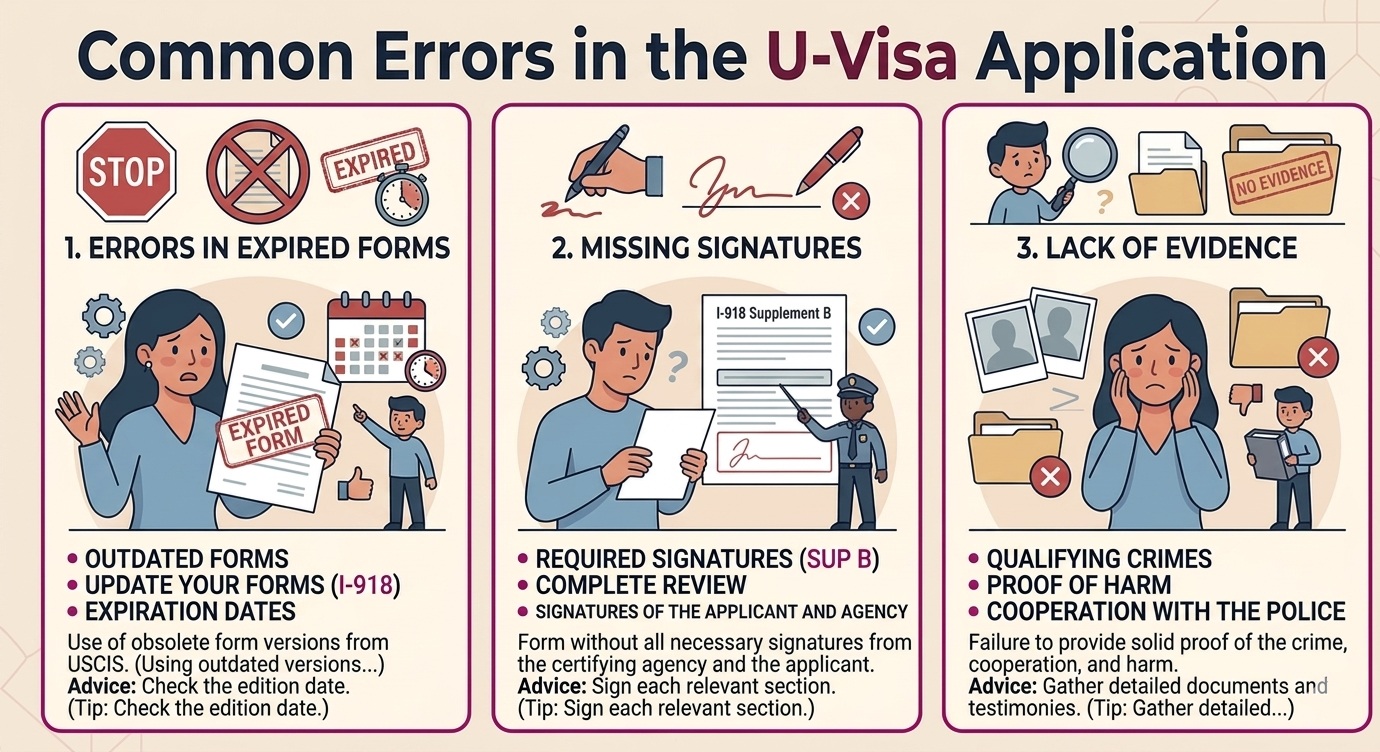
Many U Visa denials happen because of filing errors, expired certifications, weak evidence of substantial harm, or missing immigration waivers.
Common U Visa Errors and I-918 Mistakes
Some of the most common U Visa errors include:
Missing the 6-Month Deadline
Once Form I-918B is signed, applicants generally have only 6 months to submit it to USCIS.
Weak Evidence of Substantial Harm
USCIS requires evidence of substantial physical and mental abuse.
Helpful evidence may include:
psychological evaluations,
therapist letters,
medical records,
photographs,
and sworn declarations.
A psychological evaluation U Visa report may help document emotional trauma and mental harm.
Waiver Problems
Some applicants require Form I-192 waivers for immigration violations or inadmissibility issues.
Failure to Respond to RFEs
Requests for Evidence (RFEs) must be answered correctly and on time. Failure to respond may result in a U Visa denial.
Speak With a Licensed Immigration Attorney
U Visa cases involve strict USCIS requirements, certifications, deadlines, and supporting evidence. Your (future) experienced immigration lawyer may help evaluate:
qualifying crimes,
certification eligibility,
inadmissibility waivers,
police cooperation,
and supporting documentation.
Let’s Turn Your Fear Into a Future
Every case at Elizabeth Rosario Law starts with a private, free case evaluation. We will look at your visa case, and help you understand exactly which "hidden paths" are open to you. Ready to take the first step? Don't let another day go by feeling unprotected.
[Schedule Your FREE Evaluation Today]
Our immigration lawyers have helped over 10,000 families navigate the immigration system. We are proud of our 14+ years of dedicated immigration advocacy.
Call (855) 627-2292 | Serving clients in all 50 states with offices in Wyoming, Michigan; and Charlotte, North Carolina.
Disclaimer: This content is for general informational purposes only and does not constitute legal advice. Immigration laws change frequently and the information here may not reflect the most current legal developments. Consult an attorney for advice on your specific situation.
Elizabeth Rosario, Esq.
Immigration Attorney with over 14 years of experience helping families navigate complex immigration matters.
Newsletter
Subscribe to our newsletter for important immigration law updates and resources for your case.
We respect your privacy. You can unsubscribe at any time.